The primary role of industrial bearings is to reduce friction between moving components, improving operational efficiency and extending the service life of equipment. By enabling smooth and controlled motion, bearings help minimize wear, lower energy consumption, and preserve the integrity of mechanical systems.
These performance characteristics are especially critical in high-speed and high-load applications, where bearing stability and reliability directly influence productivity, maintenance intervals, and overall system performance.
Ball Bearings
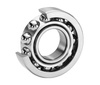
Ball bearings are a fundamental element in mechanical engineering, designed to reduce rotational friction while supporting both radial and axial loads. Their construction—consisting of precision balls positioned between inner and outer races—minimizes surface contact, allowing components to move efficiently and consistently across a wide range of applications.
Roller Bearings
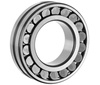
Roller bearings use cylindrical rollers instead of balls, providing a larger contact area between the rolling elements and the raceway. This design enables them to support higher load capacities, making roller bearings well suited for demanding applications involving heavy loads and continuous operation.
Spherical Plain Bearings
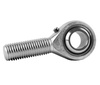
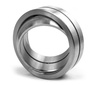
Spherical plain bearings are engineered to withstand heavy loads while allowing smooth rotational movement. Their spherical design permits angular motion in multiple directions, making them ideal for applications that require alignment flexibility and multi-directional movement.
Mounted Bearings
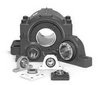
Mounted bearings are housed within protective units that are directly installed onto machine frames or integrated into system designs. They offer enhanced stability, ease of installation, and reliable performance in applications where durability and load resistance are essential.
Plain and Sleeve Bearings
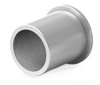
Plain bearings, also known as slide bearings, are valued for their simple construction, durability, and cost-effectiveness. Sleeve bearings, a cylindrical form of plain bearing, provide high load-carrying capacity and are commonly manufactured from materials such as bronze, plastic, or composite compounds. These materials often offer self-lubricating properties, ensuring smooth operation with minimal maintenance requirements.
Cam and Yoke Roller Bearings
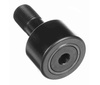
Cam and yoke roller bearings are designed to handle high radial loads and are frequently used in applications involving linear motion or the conversion of rotational movement into linear motion. Cam rollers typically feature thick-walled outer rings to withstand heavy loads and reduce deformation, while yoke rollers are mounted on pins or shafts to provide increased load capacity and rigidity in track and conveyor systems.
At BBMPS, we provide a comprehensive range of bearing solutions designed to meet diverse technical specifications and industrial requirements. Our portfolio supports applications across automation, manufacturing, material handling, and heavy-duty machinery. Request a quote today to identify the right bearing solution for your equipment and operating conditions.